


News Center
Focus on new trends in enterprise development and record every step forward.
The role of hydrolyzer in the production of industrial cellulose acetate flakes
In the industrial scale production of cellulose acetate flakes (CA) (mainly used in cigarette filter bundles, plastics, films, and other fields), the main function of the hydrolyzer is to control the hydrolysis reaction, accurately adjust the degree of substitution of acetyl groups in cellulose molecules, and convert cellulose triacetate into cellulose triacetate with good solubility and specific performance requirements.
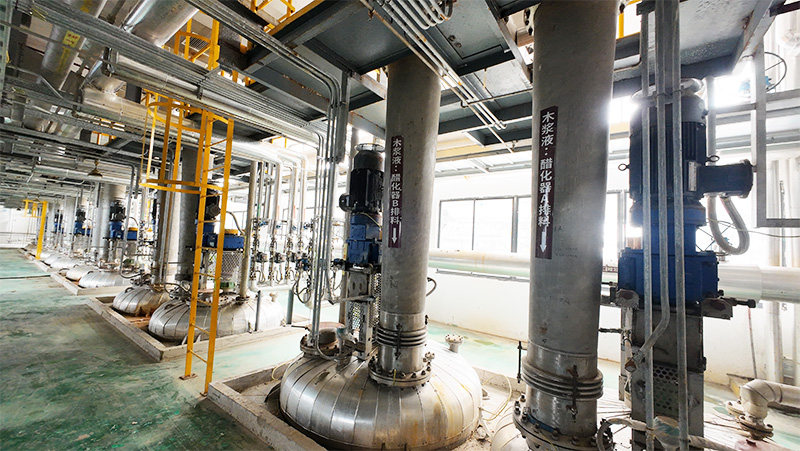
ONE、 The core function of the hydrolysis device
1. Adjust the degree of acetyl substitution
Each glucose unit in cellulose molecules originally contains three hydroxyl groups (- OH). In the acetylation reaction, these hydroxyl groups react with acetic anhydride (acetylating agent) and are partially or completely replaced by acetyl groups (- OAc) to form cellulose triacetate (acetyl substitution degree ≈ 3).
The hydrolyzer controls the hydrolysis conditions (such as temperature, time, acid concentration) to hydrolyze and detach some acetyl groups, reducing the degree of substitution to the typical range of cellulose acetate (average acetyl number ≈ 2.4). This process directly determines the solubility, mechanical properties, and final application performance of the product.
2. Optimize product solubility
Cellulose diacetate needs to be dissolved in organic solvents such as acetone for subsequent spinning or shaping. The hydrolyzer precisely controls the degree of hydrolysis to ensure that the product can be fully dissolved while avoiding excessive hydrolysis that may cause molecular chain breakage or performance degradation, thus meeting the requirements of spinning process for slurry viscosity and spinnability.
3. Stable product quality
The hydrolysis process requires strict control of reaction conditions (such as medium temperature of 50-100 ℃ or high temperature of ≥ 100 ℃) to balance reaction rate and product stability. The hydrolyzer reduces side reactions such as residual hemicellulose acetate or cellulose degradation by precisely regulating these parameters, ensuring consistency in product performance between batches.
TWO、 The Influence of Hydrolyzer on Product Performance
1. Solubility
The degree of hydrolysis directly affects the dissolution rate and solution viscosity of cellulose acetate in acetone. Moderate hydrolysis can improve solubility and facilitate spinning process operation; Excessive hydrolysis may lead to low viscosity of the solution, affecting the quality of fiber forming.
2. Mechanical properties
The degree of acetyl substitution is closely related to the tensile strength, modulus, and elongation at break of cellulose acetate. By precisely controlling the degree of substitution, the hydrolysis machine can optimize the mechanical properties of the product and meet the needs of different application scenarios (such as high strength and elasticity for cigarette filters, and soft hand feel for textile fibers).
3. Filtration efficiency (in the tobacco industry)
In the production of acetate fiber bundles for tobacco use, the hydrolyzer needs to ensure that the product has a uniform pore structure and surface morphology to efficiently intercept tar and particulate matter in the flue gas, while maintaining low airflow resistance.
Latest News
-
What is cellulose acetate material
2026-04-11 -
Filtration Principles and Main Types of Cellulose Acetate Cigarette Filters
2026-04-08 -
Quality Inspection Report on Industrial Diacetate Cellulose White Powder
2026-04-07 -
Physical and Chemical Properties of White Powder of Cellulose Diacetate
2026-04-03 -
Acetate cellulose sheet raw material industrial use Acetate cellulose powder
2026-04-02 -
Which specification of cellulose acetate is better for leather
2026-03-10
Related Information
-
What is cellulose acetate material
2026-04-11 -
Filtration Principles and Main Types of Cellulose Acetate Cigarette Filters
2026-04-08 -
Quality Inspection Report on Industrial Diacetate Cellulose White Powder
2026-04-07 -
Physical and Chemical Properties of White Powder of Cellulose Diacetate
2026-04-03 -
Acetate cellulose sheet raw material industrial use Acetate cellulose powder
2026-04-02 -
Application of cellulose acetate sheet in the eyewear industry
2026-04-01
Message
We won't track your information when you visit our site. But in order to comply with your preferences, we'll have to use just one tiny cookie so that you're not asked to make this choice again.