


News Center
Focus on new trends in enterprise development and record every step forward.
Process flow of industrial grade spinning cellulose acetate flakes
The core goal of producing industrial grade spinning cellulose acetate is to produce cellulose acetate flakes or particles for spinning, and the final product is cigarette filter tow or textile acetate fiber.
This process is significantly different from the eyeglass sheet level, as it focuses more on producing raw materials suitable for dissolution and dry spinning, with specific rheological properties and chemical purity. The process flow can be summarized as follows: pulp preparation → esterification and hydrolysis → precipitation and refining → drying and granulation.
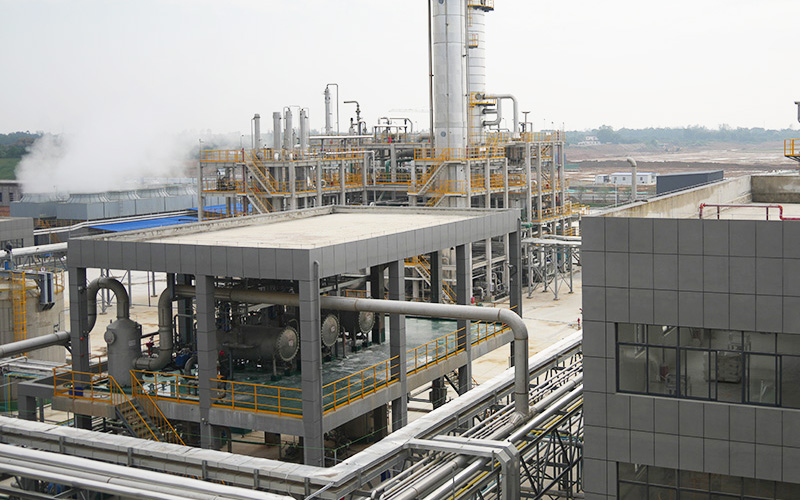
Core process objectives
High solubility: It must have good and uniform solubility in acetone (the main solvent for dry spinning) to form a viscosity stable and filterable spinning solution.
Spinnability: The solution must have good spinning properties and be able to stably stretch and solidify during the spinning process.
Specific performance: For cigarette tow, there are strict requirements for acetic acid value (combined with acetic acid content, about 54.5%~55.5%), viscosity, and filtration performance (such as pressure drop).
Cost and scale: Pursuing large-scale, continuous production to reduce unit costs.
Detailed production process flow
Phase 1: Raw material preparation and pretreatment
Raw materials: Use refined wood pulp with high alpha cellulose content (dissolved pulp), requiring low impurities and uniform polymerization degree. This is the foundation for ensuring uniform subsequent reactions and stable product quality.
Crushing and activation:
Crush the pulp board into small pieces or flocs.
In the activation machine, soak and stir the cellulose fibers with glacial acetic acid at room temperature or slightly higher temperature to fully swell them, destroy their crystallization zone, and improve accessibility. Activation is a key step in improving the uniformity and efficiency of esterification reactions.
Second stage: Acetylation reaction (esterification)
This is the core link of continuous production.
Ingredients and Mixing: Activated cellulose (containing excess glacial acetic acid) is continuously fed into a pre cooled mixer in precise proportions with acetic anhydride, glacial acetic acid, and catalyst (usually concentrated sulfuric acid or perchloric acid).
Reaction:
The mixed material enters the acetylation reactor (usually a kneading machine or horizontal reactor with strong stirring and jacket cooling).
The reaction is carried out at strictly controlled low temperatures (usually below 30 ℃). This is a strongly exothermic reaction that requires efficient removal of heat to prevent local overheating and side reactions.
The endpoint of the reaction is marked by the complete dissolution of cellulose and the formation of a homogeneous and viscous cellulose triacetate acetic acid solution.
Phase 3: Partial hydrolysis (maturation)
Objective: To control the hydrolysis of cellulose triacetate obtained above, remove some acetyl groups, and transform it into acetone soluble cellulose diacetate. The degree of hydrolysis determines the acetic acid value and solubility of the final product.
Process:
Add a calculated amount of dilute acetic acid aqueous solution (sometimes with a small amount of sulfuric acid to promote hydrolysis) to the mucus that has completed the reaction.
Hydrolysis is carried out under heating conditions (such as 40-60 ℃) and precise timing. Small changes in temperature and time can significantly affect the degree of polymerization and acetyl distribution of the final product.
Through online viscosity monitoring or sampling analysis, the hydrolysis endpoint can be precisely controlled to achieve the target range of acetic acid value (such as 55.0% ± 0.2%).
Stage Four: Precipitation, Washing, and Refinement
This is the key to purifying products, removing impurities, and catalysts.
Precipitation: Slowly add the hydrolyzed qualified mucus to a large amount of dilution water (usually deionized water or soft water), and the cellulose acetate precipitates out in the form of white flocs, forming a slurry.
Washing and Stability:
Pass the slurry through a multi-stage countercurrent washing system (such as belt filter, vacuum drum filter).
Wash repeatedly with plenty of hot water to thoroughly remove residual impurities such as acetic acid, sulfuric acid, and sulfate esters. Incomplete washing can lead to poor thermal stability and yellowing of the product color.
In the later stage of washing, stabilizer solutions such as sodium acetate or magnesium acetate are usually added to neutralize residual acids and replace sulfate groups bound to cellulose molecules, significantly improving the thermal stability and whiteness of the product.
Dehydration: After washing, the wet material is passed through a centrifuge or press to remove most of the moisture, resulting in a wet cake with a moisture content of about 50% -60%.
Stage 5: Drying, Forming, and Packaging (into "slices")
Drying: After the wet cake is crushed, it is sent to an air flow drying tube or fluidized bed dryer and quickly dried with hot air to obtain a dry fluffy powder or fine flocculent material.
Granulation/Production:
In order to facilitate transportation, storage, and subsequent dissolution feeding in the spinning plant, it is necessary to shape the fluffy powder into high-density regular shapes.
Main method: The dried powder is fed into a roller press and pressed into continuous and dense flakes under high pressure. Then, it is crushed and sieved to obtain uniformly sized flake particles (Flake). Sometimes extrusion granulation is also used.
Homogenization and packaging:
Mix (homogenize) particles from different batches on a large scale to ensure the uniformity of the final product performance.
Detect key indicators such as acetic acid value, viscosity, moisture, solubility, etc. of the product.
Qualified products are packaged in moisture-proof bags and sent to the spinning workshop or factory.
Brief description of the subsequent process at the spinning end
After obtaining this cellulose acetate sheet, the spinning factory will proceed with:
Dissolve: Mix the sheet with acetone in a dissolution kettle to prepare a spinning solution with a concentration of about 20% -30%.
Filtration and defoaming: Remove insoluble particles and bubbles from the original solution.
Dry spinning: The raw material is metered by a spinning pump, extruded from the fine pores of the spinning plate, and enters the spinning channel. The tunnel is filled with hot air (or nitrogen), acetone evaporates rapidly, and cellulose acetate solidifies to form continuous long fiber bundles.
Winding and post-processing: The fiber bundle is oiled, wound, and finally packaged. For cigarette filament bundles, it is necessary to perform treatments such as loosening and curling to provide appropriate hardness, elasticity, and filtration performance.
Latest News
-
What is cellulose acetate material
2026-04-11 -
Filtration Principles and Main Types of Cellulose Acetate Cigarette Filters
2026-04-08 -
Quality Inspection Report on Industrial Diacetate Cellulose White Powder
2026-04-07 -
Physical and Chemical Properties of White Powder of Cellulose Diacetate
2026-04-03 -
Acetate cellulose sheet raw material industrial use Acetate cellulose powder
2026-04-02 -
Which specification of cellulose acetate is better for leather
2026-03-10
Related Information
-
What is cellulose acetate material
2026-04-11 -
Filtration Principles and Main Types of Cellulose Acetate Cigarette Filters
2026-04-08 -
Quality Inspection Report on Industrial Diacetate Cellulose White Powder
2026-04-07 -
Physical and Chemical Properties of White Powder of Cellulose Diacetate
2026-04-03 -
Acetate cellulose sheet raw material industrial use Acetate cellulose powder
2026-04-02 -
Application of cellulose acetate sheet in the eyewear industry
2026-04-01
Message
We won't track your information when you visit our site. But in order to comply with your preferences, we'll have to use just one tiny cookie so that you're not asked to make this choice again.