


Solution
Collaborative innovation between industry, academia and research, empowering diverse application scenarios
Application of Spinning Cellulose Diacetate Flakes in Cigarette Filter Tow
Spinning cellulose diacetate Flakes are a specialized raw material for manufacturing cellulose diacetate tow, which forms the skeleton and functional core of cigarette filters. This application accounts for the vast majority of global cellulose diacetate production.
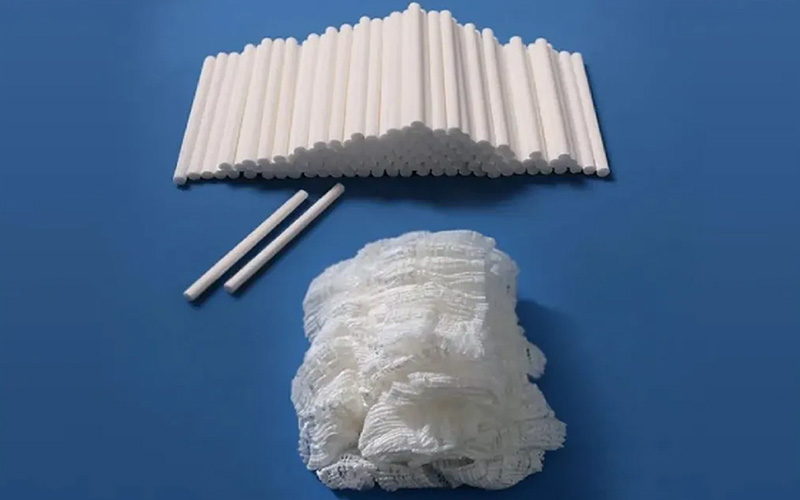
1. Cellulose Diacetate Flakes: Raw Material Characteristics and Requirements
Cellulose diacetate Flakes used for spinning are not ordinary plastics; they require a series of stringent characteristics:
High Purity and Consistency: Impurities such as lignin and hemicellulose in the raw material (wood pulp or cotton lint) must be removed to ensure a consistent chemical structure of the polymer, guaranteeing stability in the spinning process and uniform tow quality.
Specific Degree of Substitution: The degree of substitution of cellulose acetate (the average number of hydroxyl groups substituted by acetyl groups on each glucose unit) is typically between 2.3 and 2.6. This range of substitution endows the material with:
Good Solubility: It can dissolve in specific solvents such as acetone, forming a viscous solution (spinning solution) suitable for spinning.
Suitable crystallinity and mechanical properties: Ensure sufficient strength and flexibility in the final filament bundle.
Controllable molecular weight and viscosity: Molecular weight distribution affects the rheology and spinnability of the spinning solution. Viscosity must be controlled within a precise range to ensure stable fiber formation during spinning, preventing breakage or clogging of the spinneret.
Free of harmful impurities: The content of heavy metals, residual acids, and other impurities harmful to human health must be strictly controlled.
2. Manufacturing process from cellulose Flakes to filament bundle (dry spinning)
This is the core technology of the entire application, mainly using the dry spinning process:
Preparation of spinning solution: Cellulose diacetate Flakes are thoroughly mixed with acetone solvent in a mixer.
A plasticizer (most commonly triacetyl ester) is added simultaneously, which is crucial for subsequent fiber formation and filter rod hardening.
After stirring, dissolving, and degassing, a homogeneous, transparent, and viscous solution is formed, called the "spinning solution".
Spinning and forming: The spinning solution is precisely delivered to the spinning assembly via a metering pump.
In the assembly, the toluene is extruded through a spinneret with thousands of tiny orifices, forming a fine stream.
These streams enter a long, hot-air-filled spinning tunnel.
The acetone solvent evaporates rapidly under the hot air, causing the cellulose acetate to coagulate and form continuous monofilaments.
Bundling, oiling, and winding:
Thousands of monofilaments converge below the tunnel into a wide, paper-thin ribbon.
A small amount of oil is applied via an oiling roller to reduce static electricity and increase the smoothness and subsequent opening properties of the toluene.
Finally, the ribbon is wound into a large toluene roll.
3. Application and Advantages of Toluene in Cigarette Filters
The resulting cellulose diacetate toluene is transported to the cigarette factory and processed into filter rods using a filter rod forming achine:
Opening: The tightly packed toluene is unfurled, becoming fluffy.
Applying plasticizer: Triacetyl ester is sprayed again.
Forming and Curing: The filament bundle is wrapped in forming paper through a trumpet-shaped forming nozzle, forming a cylindrical shape. At this point, triacetin acts as a binder, causing the monofilaments to adhere to each other at contact points. The filament network rapidly cures and hardens, forming a filter rod with a porous structure and sufficient rigidity.
Slitting: The continuous filter rod strips are slit into individual cigarette filter lengths.
Core Advantages of Cellulose Diacetate Tow as Filter Material:
Excellent Filtration Performance: Its fiber surface has tiny grooves and a complex three-dimensional network structure, effectively capturing tar and particulate matter in cigarette smoke through mechanical interception, diffusion deposition, and inertial impaction.
Good Processing Performance: The crimp and strength of the filament bundle ensure stable operation on high-speed filter rod forming machines, making it less prone to breakage. The unique curing characteristic using plasticizers results in a filter rod with stable structure and moderate rigidity.
Selective Adsorption: It has a certain adsorption effect on some harmful components in cigarette smoke, while also retaining the mainstream flavor of the smoke well, without affecting the taste of the cigarette.
High safety: It is non-toxic and odorless, and will not pyrolyze to produce harmful substances at normal smoking temperatures. It is recognized by global health and regulatory agencies as a safe food contact grade filter material.
Clean white appearance and pleasant feel: The resulting filter tip has a clean appearance and a comfortable taste.
Spun cellulose diacetate Flakes are a crucial link in the cigarette filter rod industry chain. Through a precisely controlled dry spinning process, it is transformed into high-performance cellulose diacetate tow, ultimately becoming the most common cigarette filter tip in our daily lives.
Latest News
-
Application of cellulose acetate sheet in the eyewear industry
2026-04-01 -
Privacy Policy
2026-03-12 -
Application of cellulose diacetate powder in the acetic acid sheet industry
2025-12-11 -
Application of cellulose acetate flakes for plastic industry
2025-12-01 -
Application of Spinning Cellulose Diacetate Flakes in Cigarette Filter Tow
2025-11-28 -
Application of spinning vinegar flakes in the manufacturing of textile filament bundles
2025-11-27
Related Information
-
What is cellulose acetate material
2026-04-11 -
Filtration Principles and Main Types of Cellulose Acetate Cigarette Filters
2026-04-08 -
Quality Inspection Report on Industrial Diacetate Cellulose White Powder
2026-04-07 -
Physical and Chemical Properties of White Powder of Cellulose Diacetate
2026-04-03 -
Acetate cellulose sheet raw material industrial use Acetate cellulose powder
2026-04-02 -
Application of cellulose acetate sheet in the eyewear industry
2026-04-01
Message
We won't track your information when you visit our site. But in order to comply with your preferences, we'll have to use just one tiny cookie so that you're not asked to make this choice again.