


News Center
Focus on new trends in enterprise development and record every step forward.
Production process of acetate fiber yarn
Acetate fiber yarn is a high-end synthetic fiber yarn made from natural wood pulp through chemical modification. Its production process integrates chemical engineering and textile technology, with precise processes and strict requirements. The following is a detailed explanation of its core production process:
ONE、 Preparation of Acetate Fiber (Chemical Section)
This is the source step that distinguishes acetate fiber from other yarn production.
1. Raw material preparation: The main raw material is high-purity wood pulp (with high alpha cellulose content). Pre treat it with glacial acetic acid to generate cellulose acetate.
2. Esterification reaction: Pre treated cellulose undergoes esterification reaction with acetic anhydride under the condition of sulfuric acid as a catalyst, producing cellulose triacetate.
3. Hydrolysis (partial saponification): Controlled hydrolysis of cellulose triacetate in dilute acetic acid solution to reduce esterification degree and transform it into cellulose diacetate soluble in acetone. This is the current mainstream chemical form of "acetate fiber" in the market.
4. Precipitation and washing: The hydrolyzed cellulose acetate solution is precipitated in water to form a white flocculent solid. Subsequently, after thorough washing, residual acid and catalyst are removed.
5. Drying and granulation: The washed cellulose acetate is dried and then usually made into flakes or granules for storage and transportation. This is the raw material for spinning - cellulose acetate slices.
TWO、 Spinning Forming (Physical Part)
Transform solid cellulose acetate into continuous fibers.
1. Preparation of spinning solution (spinning solution): Dissolve dried cellulose acetate slices in acetone to prepare a transparent spinning solution with a concentration of about 20-30% and uniform viscosity. The solution needs to undergo precise filtration to remove impurities and insoluble particles.
2. Dry spinning: This is a landmark process in the production of acetate fibers.
The spinning solution is extruded through a metering pump and a spinneret (with hundreds to thousands of micropores) to form a fine stream.
The fine stream enters a spinning channel filled with hot air (~100 ° C).
In the tunnel, the solvent acetone rapidly evaporates and is carried away and recovered by hot air. As acetone evaporates, the fine stream of cellulose acetate solidifies and stretches, forming continuous filaments.
Dry spinning endows acetate fibers with unique qualities such as smooth surface, approximately circular cross-section, and elegant luster.
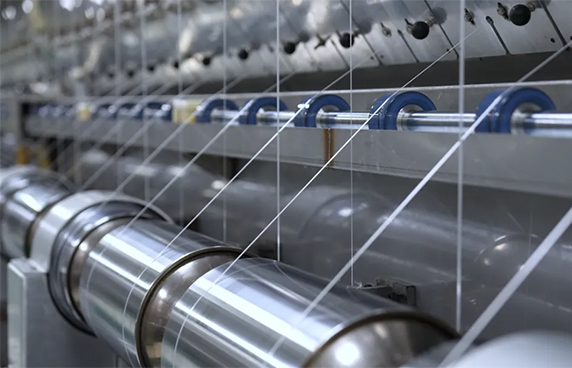
3. Oiling and winding: After forming, the fibers are bundled and coated with spinning oil to give them flexibility, anti-static properties, and gripping force. Finally, they are wound at high speed onto a tube to obtain acetate fiber filament tubes.
3、 Post processing and yarn shaping (textile part)
The spun filament is processed according to its final use.
1. Twisting:
Single filament twisting: Combining multiple single filaments and increasing their strength, grip, and style through twisting. Twist can be adjusted according to fabric requirements (such as high twist used for "acetate satin").
Twisting of Strands: Combine and twist the twisted single yarns again to make thicker and more stable strands.
2. Setting (heat setting): Steam or heat setting is applied to the twisted yarn to stabilize the twist and prevent tangling or shrinkage during subsequent processing or use.
3. Winder: Re wind the yarn onto a standard specification tube, remove defects (such as coarse knots, details, etc.), and make the package suitable for high-speed weaving or knitting.
4. Packaging: After passing the inspection, package according to specifications and weight.
Main product forms:
Long thread: The most common form used for high-end fashion, lining fabrics, satin, etc.
Short fiber: made by cutting long fibers, can be spun pure or blended with cotton, silk, polyester, etc.
Special yarns: such as high elasticity yarns (modified physically or chemically), irregular cross-section yarns, glossy/matte yarns, etc.
The essential production process of acetate fiber yarn is to modify natural cellulose through acetylation, dissolve it in acetone, and use dry spinning technology to evaporate the solvent, thereby regenerating and solidifying it into fibers, which are then processed into yarn through textile twisting technology. The entire process is technology intensive, particularly relying on precise control of chemical processes and dry spinning parameters to produce high-quality yarn with a silky luster, smooth hand feel, good drape, easy to dye bright colors, and not prone to static electricity. Its disadvantage is relatively low strength and poor wet strength, but it can be improved by compounding with other fibers or optimizing the process.
Latest News
-
What is cellulose acetate material
2026-04-11 -
Filtration Principles and Main Types of Cellulose Acetate Cigarette Filters
2026-04-08 -
Quality Inspection Report on Industrial Diacetate Cellulose White Powder
2026-04-07 -
Physical and Chemical Properties of White Powder of Cellulose Diacetate
2026-04-03 -
Acetate cellulose sheet raw material industrial use Acetate cellulose powder
2026-04-02 -
Which specification of cellulose acetate is better for leather
2026-03-10
Related Information
-
What is cellulose acetate material
2026-04-11 -
Filtration Principles and Main Types of Cellulose Acetate Cigarette Filters
2026-04-08 -
Quality Inspection Report on Industrial Diacetate Cellulose White Powder
2026-04-07 -
Physical and Chemical Properties of White Powder of Cellulose Diacetate
2026-04-03 -
Acetate cellulose sheet raw material industrial use Acetate cellulose powder
2026-04-02 -
Application of cellulose acetate sheet in the eyewear industry
2026-04-01
Message
We won't track your information when you visit our site. But in order to comply with your preferences, we'll have to use just one tiny cookie so that you're not asked to make this choice again.